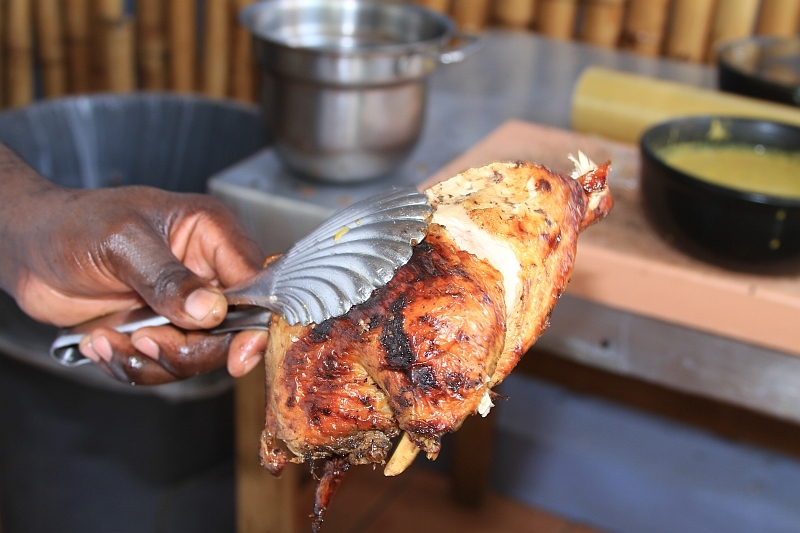
Ask anyone to name a Caribbean dish and the answer is almost always the same: jerk chicken. Which is fair — Jamaican jerk is one of the world's great flavor achievements. But the Caribbean is 7,000 islands spanning 2.5 million square kilometers, home to people descended from West Africans, Indians, Chinese, Europeans, and indigenous Amerindians. To stop at jerk chicken is to read the first page of a novel and call it done.
These are the Caribbean recipes that most people outside the islands have never encountered — and every single one deserves a place in your kitchen.
Barbadian Cou-Cou and Flying Fish: The Caribbean's Most Patriotic Plate
Barbados calls itself "Little England" but its national dish is entirely African in origin. Cou-cou — silky, smooth cornmeal stirred with okra until it holds its shape — is the direct cousin of West African fufu and Southern American grits. The enslaved cooks who created it were brilliant practical engineers, transforming a cheap starch into something that could absorb and carry flavor. Serve it with flying fish — those extraordinary creatures that actually glide above the ocean surface on wing-like fins — steamed in a bright, peppered tomato sauce, and you have a meal that is both humble and absolutely perfect.
Flying fish appears on Barbados's coat of arms. The cou-cou stick used to stir the dish is a national symbol. This is food as patriotism, and it tastes exactly as serious as that sounds.
Trinidadian Doubles: The Breakfast That Changed Everything
In Trinidad, the morning begins differently. Street vendors set up their carts before dawn, and by 7am the line for doubles stretches around the block. The dish is deceptively simple: two soft fried bara (flatbreads) loaded with curried chickpeas (channa) and finished with chutneys — tamarind, cucumber, pepper, shadon beni. It costs almost nothing. It takes about 90 seconds to eat. It is extraordinary.
Doubles emerged from Trinidad's Indo-Caribbean community, the descendants of Indian indentured laborers who arrived after emancipation. They brought the flavors of Punjab — chickpea curry, flatbread, turmeric, cumin — and then transformed them entirely using local ingredients and generations of taste. The result is something that belongs completely to Trinidad and to nowhere else on Earth. If you eat only one Caribbean street food in your lifetime, make it this one.
Haitian Griot with Pikliz: Flavor Built on Fire
Haiti's griot is marinated, braised, then fried pork shoulder — crispy outside, impossibly tender inside, deeply seasoned with citrus, thyme, and Haitian epis (the fragrant herb paste that forms the backbone of almost every Haitian savory dish). But the magic isn't the pork — it's the pikliz served alongside it.
Pikliz is Haitian pickled cabbage and Scotch bonnet relish, fermented in vinegar until it achieves a heat and acidity that cuts right through the richness of the fried pork. It is the best condiment in the Caribbean, and it's barely known outside Haitian communities. The combination of griot and pikliz is one of those food pairings where you wonder how anyone discovered it — the answer is: someone was paying very close attention.
Guyanese Pepper Pot: The Stew That Never Ends
Guyana sits on the South American continent, not technically in the Caribbean Sea — but culturally, culinarily, and spiritually it belongs to the Caribbean world. And its contribution to the culinary canon is one of the most remarkable dishes in the entire hemisphere: pepper pot.
The key ingredient is cassareep: a thick black syrup reduced from bitter cassava juice, an ancient Amerindian preserving agent that was being used in Guyana's kitchen for centuries before Columbus arrived. Cassareep prevents spoilage naturally. A pepper pot pot left at room temperature, brought to a boil every day and refreshed with new meat and more cassareep, can theoretically keep going indefinitely. Some Guyanese families claim their pepper pot is decades old.
The stew itself is black, sweet-savory, spiced with cinnamon and cloves and whole Scotch bonnet peppers (intact, for flavor rather than heat), and so viscous it coats everything it touches. Eaten on Christmas morning with soft white bread rolls for mopping, it tastes like something irreplaceable — because it is.
What the Caribbean Gets Right That the Rest of the World Misses
Caribbean cooking is built on layers of cultural history in a way that's unlike almost any other cuisine. Every dish is a record of survival, migration, and transformation. The African culinary knowledge carried across the Atlantic in the most brutal circumstances imaginable became the foundation of an entirely new food culture. Indian indenture brought a second wave of complex spice traditions that merged with what was already there. Indigenous Amerindian ingredients like cassava, cassareep, and wiri wiri peppers formed the deep root system beneath it all.
The result is a cuisine that is simultaneously very old and very new, deeply local and globally diverse. No two Caribbean islands taste the same. Trinidad doesn't taste like Barbados. Jamaica doesn't taste like Guyana. The region is not a monolith — it is an argument, carried out in flavor, that is still being had.
Explore the Full Caribbean Recipe Library
These four dishes are a starting point. The full Caribbean collection on FlavorBridge covers the breadth of island cooking — from Jamaican jerk chicken (the recipe that started it all, and still one of the best things you can cook on a weekend) to dishes you've almost certainly never heard of. Every recipe comes with the cultural story behind it, because Caribbean food divorced from its history is just seasoned protein. The story is the point.
Start with the dish that surprises you most. That's always the right one to try first.